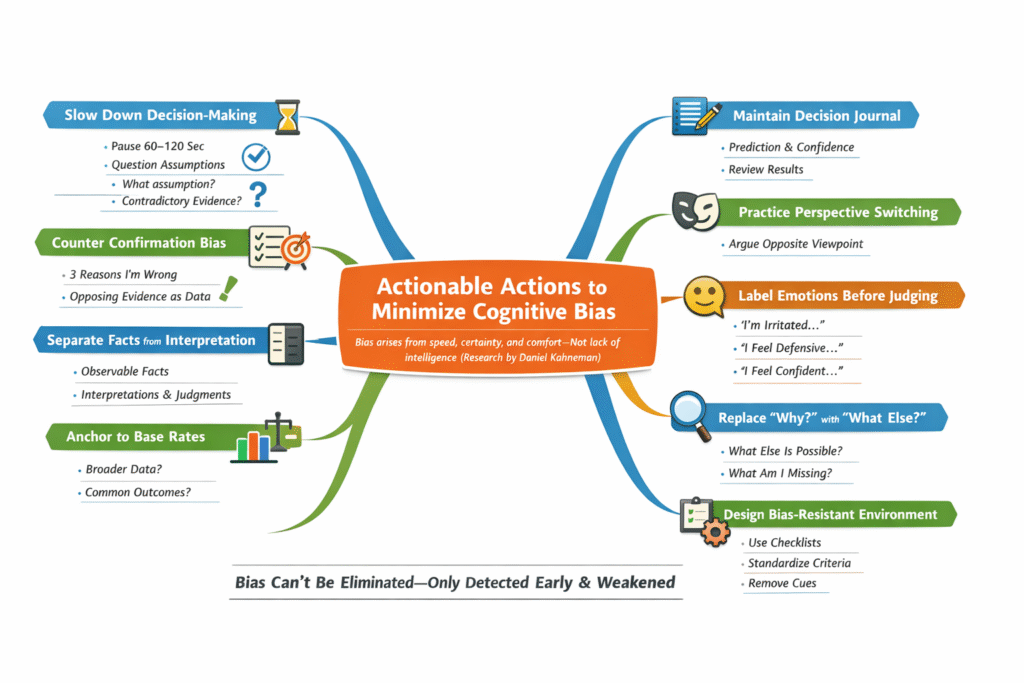
Cognitive biases distort judgment not because people lack intelligence, but because the brain prioritizes speed, certainty, and emotional comfort over accuracy. As shown by behavioral research from Daniel Kahneman, bias reduction requires behavioral systems, not willpower.
“The human mind is a machine for jumping to conclusions.” — Daniel Kahneman
1. Slow down Decision-Making to Reduce Decision Bias
Action
- Introduce a mandatory pause before important decisions (60–120 seconds).
- Ask:
- What assumption am I making?
- What evidence contradicts it?
Why it works
Fast thinking amplifies bias. Deliberate slowing activates analytical reasoning and reduces impulsive errors.
2. Actively Seek Evidence to counter confirmation bias
Action
- For any strong belief, write down three reasons why it might be wrong.
- Treat opposing evidence as data—not a threat.
Why it works
Bias survives by filtering out contradiction. This forces cognitive balance.
3. Separate Facts from Interpretation in order to distinguish between perception vs. Reality
Action
Use a two-column method:
- Column 1: Observable facts
- Column 2: Interpretations, assumptions, judgments
Why it works
Most bias enters during interpretation, not observation.
4. Anchor Judgments to Base Rates to promote statistical thinking
Action
Before trusting anecdotes or personal experience, ask:
- What usually happens in this situation?
- What does the broader data say?
Why it works
Bias exaggerates rare events and personal stories. Base rates restore proportional reasoning.
5. Maintain a Decision Journal for exposing recurring thinking errors
Action
For important decisions, record:
- Your prediction
- Confidence level
- Reasoning
Review outcomes later.
Why it works
Bias rewrites memory. Journaling exposes recurring thinking errors.
6. Practice Perspective Switching to reduce personal bias
Action
Argue your position from the viewpoint of:
- Someone who disagrees
- Someone affected by your decision
- Someone with opposite incentives
Why it works
Bias strengthens when beliefs are tied to identity. Perspective breaks ego-lock.
7. Label Emotions Before Judging for Controlling Bias
Action
When emotions arise, name them explicitly:
- “I’m irritated”
- “I feel defensive”
- “I feel confident without evidence”
Delay conclusions.
Why it works
Emotional awareness reduces their unconscious influence on reasoning.
8. Replace “Why?” With “What Else?” to foster critical thinking
Action
Instead of asking why something happened, ask:
- What else could explain this?
- What am I missing?
Why it works
“Why” creates stories. “What else” creates accuracy.
9. Reduce Bias Through Environmental Design for the reduction of behavioural bias
Action
- Use checklists
- Standardize evaluation criteria
- Remove irrelevant cues (names, appearances, status)
Why it works
Bias is situational. Change the environment, not just the mindset.
As Daniel Kahneman demonstrated, better decisions do not come from stronger willpower or higher intelligence, but from systems that slow us down, expose assumptions, and force us to consider alternative viewpoints.
The practices you outlined—pausing decisions, separating facts from interpretation, anchoring to base rates, journaling outcomes, switching perspectives, and redesigning environments—share one core principle:
They create distance between perception and conclusion.
That distance is where clarity emerges.
Importantly, the goal is not to become bias-free. The realistic goal is to detect bias earlier, weaken its grip, and prevent it from hardening into belief. In the end, minimising cognitive bias is less about thinking harder and more about thinking more honestly—about what we know, what we assume, and what we are unwilling to question.