
1. Introduction
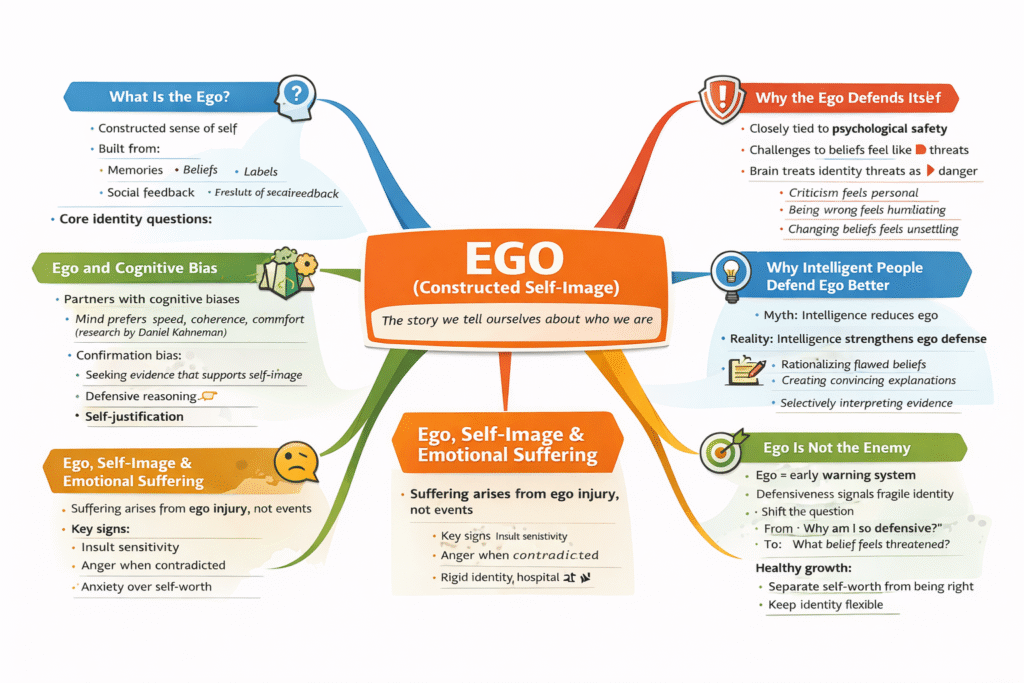
The ego is the story we tell ourselves about who we are. In modern psychology views it more broadly as the constructed sense of self—built from memories, beliefs, labels, and social feedback.
The ego answers questions like:
- Who am I?
- What kind of person am I?
- How do others see me?
Once formed, this identity seeks consistency, not accuracy.
“The ego protects identity, not truth.”
2. Ego Feels the Need to Defend Itself
The ego is closely tied to psychological safety. When your beliefs, opinions, or self-image are challenged, the brain does not treat it as an abstract disagreement—it treats it as a threat.
Neuroscience shows that perceived threats to identity activate the same stress responses as physical danger. This explains why:
- Criticism feels personal
- Being wrong feels humiliating
- Changing beliefs feels unsettling
The ego defends itself because uncertainty make us feel unsafe.
3. Ego and Cognitive Bias: A Powerful Alliance
The ego does not work alone. It partners with cognitive biases to protect identity. Daniel Kahneman shows that the mind prefers speed, coherence, and emotional comfort over truth. Once the ego adopts a belief, biases step in to defend it.
This leads to:
- Confirmation bias: Seeking evidence that supports who we think we are
- Self-serving bias: Attributing success to ability and failure to external factors
- Defensive reasoning: Explaining away uncomfortable facts
The result is self-justification.
4. Why Smart People Defend the Ego Even Better
A common myth is that intelligence reduces ego. In reality, intelligence often strengthens ego defense.
Smarter individuals are better at:
- Rationalizing flawed beliefs
- Constructing convincing explanations
- Selectively interpreting evidence
This is why debates rarely change minds. The ego is not asking, “Is this true?”
It is asking, “Does this protect who I think I am?”
5. Ego and Emotional Suffering
Much of emotional suffering arises not from events, but from ego injury.
Examples include:
- Feeling insulted when not acknowledged
- Feeling angry when contradicted
- Feeling anxious when self-worth feels unstable
When identity is rigid, life feels like a constant negotiation to protect it. The stronger the attachment to self-image, the greater the emotional suffering.
6.Ego Is Not the Enemy
The ego cannot be eliminated because it is a functional psychological structure. What can change is our relationship to it.
The ego is not your enemy and it is early warning system. Its defensiveness signals areas where identity is fragile.
Instead of asking:
- Why am I so defensive?
A more useful question is:
- What belief about myself feels threatened right now?
Healthy psychological growth involves:
- Separating self-worth from being right
- Allowing identity to remain flexible
This shift creates psychological resilience. When the ego loosens its grip, learning becomes possible. That question opens the door to self-awareness instead of self-protection.
7.Final Takeaway
The psychology of ego explains why humans defend beliefs, resist change, and struggle with criticism—even when evidence is clear. The ego prioritizes identity over accuracy, comfort over growth.
Freedom does not come from destroying the ego, but from seeing it clearly.
The ego does not weaken through self-criticism or humility displays.
It weakens when it stops being needed for psychological safety.