
“You suffer more from imagined conversations than from real ones.”
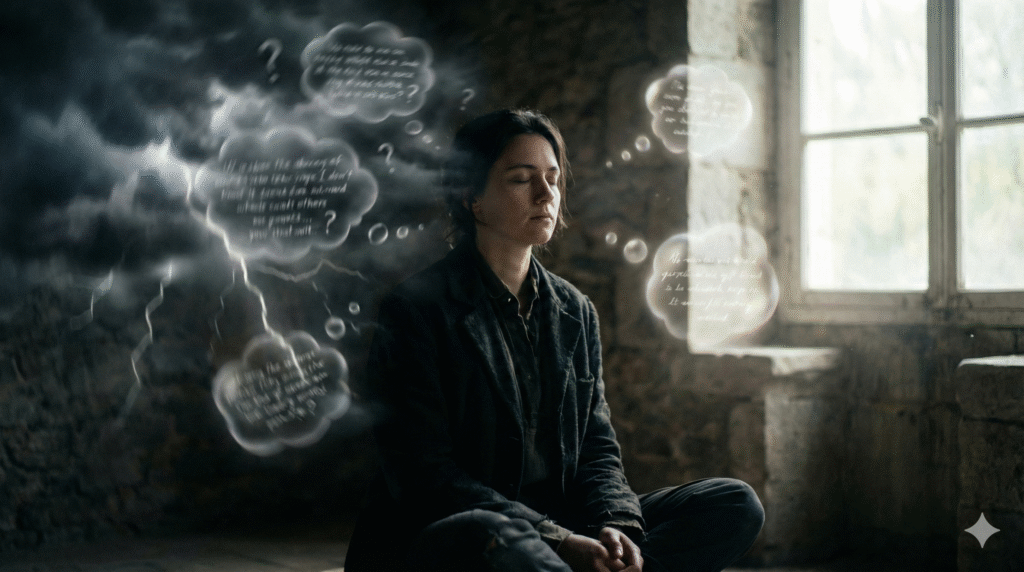
1. What Is Overthinking?
Overthinking is the mental replay of thoughts without any action. It usually involves:
- repeatedly analysing past events
- anticipating negative future outcomes
- mentally rehearsing conversations
- questioning one’s own decisions and worth
Unlike purposeful thinking, overthinking:
- does not lead to clarity
- does not lead to any action or outcome
2. Why Overthinking Leads to Anxiety
Anxiety is caused by thoughts about future events which are uncertain.
When the mind overthinks, it constantly asks:
- “What if something goes wrong?”
- “What if I fail?”
- “What if my impression goes wrong?”
These questions trigger the body’s stress response even though no immediate danger exists. The nervous system reacts as if the imagined scenario is already happening.
As a result:
- The body stays tense
- The mind becomes hypervigilant
Overthinking keeps anxiety alive by never allowing uncertainty to settle.
3. The Role of Memory in Emotional Suffering
Overthinking is rarely about the present moment. The present moment is free from anxiety.
It is usually about:
- replaying past mistakes
- reinterpreting old conversations
- assigning new meanings to old events
Each replay strengthens emotional memory. The body responds again and again, even though the event has long passed.
This is why emotional pain often outlives the situation that triggered it.
4. How Overthinking Distorts Reality
Overthinking narrows perception.
Instead of seeing events as complex and fluid, the mind:
- focuses on worst-case interpretations
- ignores neutral or positive information
- treats assumptions as facts
5. Overthinking and Self-Image
One of the most overlooked causes of overthinking is self-image.
Overthinking intensifies when thoughts threaten identity:
- “What does this say about me?”
- “How do I appear to others?”
- “What if I’m not good enough?”
In these moments, thinking is not about understanding reality. It is about protecting an image of the self.
The mind believes self-image is at risk—even when it isn’t.
6. Awareness: The Shift That Reduces Overthinking
Relief does not come from eliminating thoughts. It comes from seeing thoughts as mental events, not commands.
When awareness notices:
- “This is a thought, not a fact”
- “This is memory, not the present”
- “This is anticipation, not reality”
…the emotional charge begins to weaken.
Thoughts still appear, but they no longer dominate attention. The mind gradually learns that it does not need to resolve every scenario to be safe.
7. Psychological Space
As overthinking reduces:
- anxiety softens
- emotional reactions shorten
- clarity improves
Not because life becomes predictable—but because the mind stops arguing with uncertainty.
8. Final Thoughts
Overthinking does not mean something is wrong with you.
It means the mind is trying—ineffectively—to create certainty and protect identity.
Once awareness increases:
- thoughts lose their urgency
- anxiety loses its fuel
emotional suffering becomes optional rather than inevitable